UK BioBank Data Repository Available Now

DNA

We are pleased to announce that the UK BioBank Genotyping and Imputation Data Release (data for all 500,000 participants in UK BioBank) is now available for use on central compute platforms (the CSF, DPSF and iCSF). It is also available as a storage share that can be mapped as a network drive on campus PCs / desktops.

Continue reading

New Drop in Sessions Announced

help16sm

Planning for the start of the new academic year is well under way in Research IT – we have just confirmed our next set of dates for our drop in sessions.  These sessions are specially designed to help quickly answer any queries, questions or issues you may be having with research IT including software, data visualization, research data management, sysadmin and much much more.  We can also help advise on how to include Research IT services in your grant bid proposals and how to cost for research outputs such as websites, code sharing, database distribution etc.

Continue reading

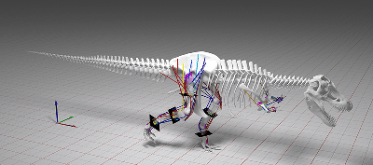
How fast can a T. rex run?

70% transparent 1000 samples Low Resolution Render

Dr William Sellers from the School of Earth and Environmental Sciences has been hitting the headlines with his discovery that Tyrannosaurus rex was unable move faster than a gentle jog, let alone run.  The research looks extensively into the gait and biomechanics of the world’s most famous dinosaur and, using the external HPC resources accessed through and supported by Research IT, has created a new simulation model to test its findings.

Continue reading

Mathematica Summer Workshop Roundup

math

Research IT recently hosted, in cooperation with Wolfram, the first Mathematica Summer Workshop. In our case “summer” only referred to the time of year and certainly not the temperature!

Mathematica is a multi-purpose scientific environment used by many researchers here at the University of Manchester. It is very good for rapid development and exploration of data, providing a convenient notebook like interface. Alternatively you can create presentations with embedded Mathematica equations as most of our presenters did. However, you certainly need to know a few tricks before getting started and that was what we aimed to provide through this workshop.

Continue reading

Wanted: Volunteer Instructors for CodeFirst

blackboard

Each semester CodeFirst runs free community courses aimed to provide women with technical and digital skills.  The courses are taught by volunteer instructors all across the country and this October they are coming to the University of Manchester.

They are looking for a diverse range of enthusiastic volunteer instructors for the upcoming autumn sessions. Instructors come from a variety of cultural and coding backgrounds, and include computer science/technical postgraduates, company based professionals, freelance developers, and university staff. All instructors work on a voluntary basis.

Continue reading

Introducing the Research Lifecycle

microsm

A guest blog post from Angus Hearmon, Head of Research IT, who introduces the Research Lifecycle project and explains what it means for researchers across the university.

The Research Lifecycle project is a program of work to deliver and embed systems and processes that enable and support researchers through the entire lifecycle of their research project from the conceptual phase through to the publication and archiving. This work will support the M2020 goal 1 of “World Class Research”.

Continue reading

Upgrade to the iCSF

circuit-board-texture-2-1184404

Research IT are pleased to announce that thanks to further investment from IT Services, the popular interactive Computational Shared Facility (iCSF) will be upgraded over the summer.  Currently the iCSF has 64GB and 256GB RAM nodes (and a 2TB node) and it will be upgraded with six new high memory 256GB nodes. The high memory nodes allow much larger datasets to be processed then can usually be done on desktops and workstations.

Continue reading

A New Way to Produce Research Papers

cohdra100_1414v2

David Mawdsley, a Research software engineer (RSE) in Research IT, presented at the recent Docker Containers for Reproducible Research Workshop (C4RR) organised by the Software Sustainability Institute.

His presentation described a new method of producing research papers using containerisation, which makes both the analysis and manuscript easy to produce and extend.  This can be used as a starting point for a new, versioned publication model, which will allow early publication of results and their incremental extension.

Continue reading